
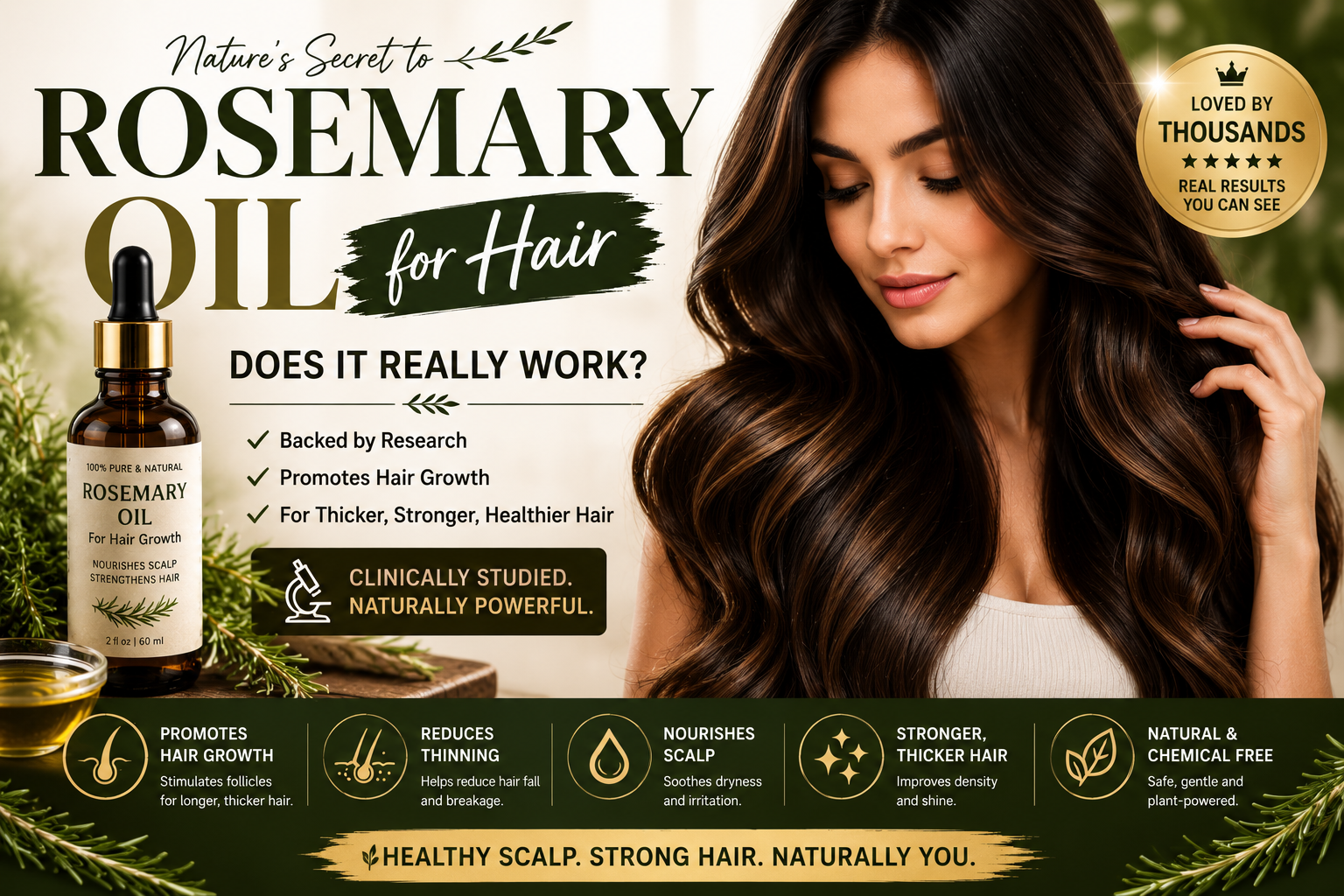
Rosemary Oil for Hair: Benefits, Uses & Does It Really Work?
If you have been looking for a natural way to improve the appearance of your hair, you have probably heard about rosemary oil for hair. This fragrant herbal oil has become one of the biggest names in natural hair care, appearing in scalp treatments, hair-growth serums, shampoos, and DIY routines.
But there is an important question behind all the hype: Does rosemary oil actually help hair grow?
The answer is more interesting than a simple yes or no.
Research suggests that rosemary oil may have potential for supporting hair growth, particularly in people with androgenetic alopecia, a common form of pattern hair loss. A randomized comparative study published in 2015 followed 100 people for six months and compared rosemary oil with 2% minoxidil. Both groups experienced a significant increase in hair count after six months, although this single study is not enough to prove that rosemary oil works for everyone or that it can replace established hair-loss treatments.
That makes rosemary oil worth discussing—but it is important to separate promising evidence from exaggerated social-media claims.
In this complete guide, we will look at the potential benefits of rosemary hair oil how to use it, how often to use it, possible side effects, what the research actually says, and whether it deserves a place in your hair-care routine.
What Is Rosemary Oil?
Rosemary oil is an essential oil derived from the rosemary plant, commonly known as Rosmarinus officinalis. Rosemary has been used for centuries in cooking, fragrance, traditional wellness practices, and beauty routines.
Unlike a regular cooking oil, rosemary essential oil is highly concentrated. That is why it is usually diluted before being applied to the scalp.
Today, rosemary oil is especially popular in natural hair care because people are interested in plant-based ingredients that may support the scalp and the appearance of thicker, healthier-looking hair.
You will find rosemary oil in many different types of products, including:
- Scalp oils
- Hair-growth serums
- Shampoos
- Conditioners
- Hair masks
- Pre-shampoo treatments
- DIY scalp treatments
However, not every rosemary product has been studied in clinical trials. A bottle that contains rosemary oil is not automatically proven to promote hair growth.

Why Is Rosemary Oil So Popular for Hair?
The popularity of rosemary oil for hair has grown rapidly because it combines several things beauty consumers are looking for: a recognizable botanical ingredient, an easy application process, and some promising scientific research.
Social media has also played a major role. Videos showing people massaging rosemary oil into their scalps have made the ingredient part of everyday beauty conversations.
But popularity should not be confused with proof.
The strongest reason to pay attention to rosemary oil is that there has been human research investigating its potential for pattern hair loss. The 2015 randomized study is particularly interesting because it compared rosemary oil directly with 2% minoxidil over six months.
At the same time, experts and researchers still need larger and better-designed studies before rosemary oil can be considered a proven treatment for hair loss.
Potential Benefits of Rosemary Oil for Hair
1. It May Support Hair Growth
Hair growth is the main reason people search for rosemary oil.
The most frequently cited clinical study involved 100 people with androgenetic alopecia. Participants were assigned to use either rosemary oil or 2% minoxidil for six months.
After three months, there was no significant change in mean hair count in either group. After six months, however, both groups had a significant increase in hair count compared with earlier measurements. The study did not find a significant difference between the rosemary oil and minoxidil groups in hair count at the six-month point.
That is encouraging, but it needs to be interpreted carefully.
It does not mean rosemary oil is proven to work exactly like minoxidil. The study was relatively small, lasted six months, and focused on a particular type of hair loss.
Still, it provides a scientific reason to investigate rosemary oil further.
2. It Can Be Part of a Healthy Scalp Routine
Your scalp is the foundation of your hair.
A gentle scalp-care routine can help you pay more attention to dryness, buildup, irritation, and other changes that may affect how your hair looks and feels.
Using a properly diluted rosemary oil product during a scalp massage can make your routine feel relaxing and intentional.
However, rosemary oil should not be viewed as a cure for scalp disorders. If you have persistent redness, severe itching, sores, unusual scaling, or sudden hair loss, it is better to seek professional advice rather than simply adding more oil.
3. It May Help Hair Look Healthier
The carrier oil used in a rosemary hair treatment can help provide a conditioning effect.
For example, jojoba, coconut, or argan oil can make hair feel softer and reduce the dry or rough feeling that some people experience.
This does not necessarily mean rosemary oil itself is growing new hair. Sometimes the improvement people notice is related to better conditioning, reduced dryness, or a more consistent hair-care routine.
4. It Fits Easily Into a Natural Hair-Care Routine
One reason people love rosemary oil for hair is that it is relatively easy to incorporate into an existing routine.
You can use a properly formulated product as a scalp treatment before shampooing, or choose a ready-made hair product that contains rosemary.
The important thing is not to assume that using more oil will produce faster results.
With essential oils, more is not always better.
Does Rosemary Oil Really Work for Hair Growth?
This is the question everyone wants answered.
Based on current evidence, rosemary oil shows potential, but it should not be called a guaranteed hair-growth treatment.
The 2015 clinical trial is the strongest commonly cited human study. Participants using rosemary oil showed increased hair counts after six months, and the results were not significantly different from the 2% minoxidil group in that particular study.
There is also newer research exploring rosemary-based formulations and delivery methods. For example, laboratory and animal research has investigated specialized rosemary-oil delivery systems and their effects on hair-related measures. These studies are interesting, but laboratory or animal findings do not automatically prove that an ordinary rosemary oil product will produce the same results in humans.

Rosemary Oil vs. Minoxidil
The comparison between rosemary oil and minoxidil is one of the biggest reasons this ingredient gets so much attention.
Minoxidil is a well-established medication used for certain types of hair loss. Rosemary oil, on the other hand, is a botanical essential oil with a much smaller evidence base.
The 2015 study compared rosemary oil with 2% minoxidil and found that both groups had increased hair counts after six months. However, that does not establish rosemary oil as a universal replacement for minoxidil or other medical treatments.
If your hair is becoming noticeably thinner, especially if the change is progressing, it is worth finding out the cause before choosing a treatment.
Hair loss can have many causes, including genetics, hormonal changes, stress, nutritional issues, medications, and scalp conditions.
How to Use Rosemary Oil for Hair
If you want to try rosemary oil for hair, keep your routine simple.
Step 1: Choose a Properly Formulated Product
If you are new to essential oils, a ready-to-use hair product may be easier than creating your own mixture.
If you purchase pure rosemary essential oil, follow the manufacturer’s dilution instructions carefully.
Step 2: Dilute Pure Essential Oil
Do not assume that applying concentrated essential oil directly to your scalp is better.
Essential oils can cause skin irritation or allergic reactions. NCCIH notes that essential oils can cause irritation or allergic reactions when they come into contact with skin, especially with prolonged exposure.
A carrier oil such as jojoba, coconut, or argan oil can be used when appropriate, but always follow the instructions for the specific product.
Step 3: Apply a Small Amount
Part your hair into sections and apply a small amount to the scalp.
There is no need to completely soak your hair.
A little can be enough to cover the areas you want to treat.
Step 4: Massage Gently
Use your fingertips rather than your fingernails.
Massage gently for a few minutes. Avoid aggressive rubbing because excessive friction can irritate the scalp.
Step 5: Wash According to the Product Directions
Some rosemary hair treatments are designed to be washed out, while others are formulated as leave-in products.
Follow the label rather than assuming that leaving oil on overnight will automatically produce better results.
How Often Should You Use Rosemary Oil?
There is no universally proven schedule that guarantees hair growth.
Many people incorporate rosemary oil into their routine several times a week, but your ideal frequency depends on the product formulation and how your scalp responds.
Start conservatively.
If your scalp becomes greasy, itchy, red, or irritated, reduce use or stop the product.
Using rosemary oil every day is not automatically better than using it less frequently.
The goal should be a routine that your scalp tolerates comfortably and that you can maintain consistently.

How Long Does Rosemary Oil Take to Work?
This is where patience matters.
Hair does not suddenly become thicker after a few applications.
The clinical study that is most often discussed evaluated rosemary oil over six months, and it did not find a significant hair-count change at the three-month checkpoint. The significant increase appeared at six months.
That gives you an important reality check.
If a social-media video promises dramatic hair growth in seven days, be skeptical.
A healthy hair-care routine should be judged over time, not after a handful of applications.
Is Rosemary Oil Good for Thinning Hair?
Rosemary oil may be worth considering as part of a hair-care routine if you are dealing with the appearance of thinning hair.
However, thinning hair has many possible causes.
If your hairline is gradually changing, your part is becoming wider, or you are noticing increased shedding, identifying the underlying reason is more important than simply choosing an oil.
Androgenetic alopecia, for example, is different from temporary shedding caused by stress or other factors.
A dermatologist can help determine what type of hair loss you are experiencing and discuss appropriate treatment options.
Possible Side Effects of Rosemary Oil
Natural does not automatically mean risk-free.
Rosemary essential oil is concentrated, and some people may experience irritation or an allergic reaction.
Possible signs of irritation can include:
- Redness
- Burning
- Itching
- Rash
- Swelling
- Increased scalp discomfort
NCCIH advises that essential oils can cause skin irritation or allergic reactions when used topically.
If you experience a significant reaction, wash the product off and stop using it.
Avoid getting essential oil into your eyes, and do not ingest products intended for topical hair use.
If you have a known skin condition, allergies, are pregnant or breastfeeding, or have questions about combining botanical products with medications, consult a qualified healthcare professional.
Who Should Avoid DIY Rosemary Oil Treatments?
DIY hair care can be fun, but it is not right for everyone.
You should be especially cautious if you have:
- A very sensitive scalp
- A history of reactions to essential oils
- An active scalp condition
- Open cuts or irritated skin
- Severe unexplained hair loss
In these situations, a dermatologist can help you decide what products are appropriate.
How to Choose the Best Rosemary Oil for Hair
If you are shopping for rosemary oil for hair, do not choose a product simply because the label says “natural.”
Look for:
- A clear ingredient list
- Clear directions for use
- Appropriate dilution information
- A reputable manufacturer
- Secure packaging
- Realistic claims
- Instructions explaining whether the product is leave-in or rinse-out
Be cautious with products promising instant regrowth, dramatic results in a few days, or guaranteed reversal of baldness.
Those claims go far beyond what current evidence can support.
Common Mistakes People Make With Rosemary Oil
Using Too Much
Soaking your scalp in oil will not guarantee better results.
Applying Pure Essential Oil
Concentrated essential oil can irritate the skin. Proper dilution or a professionally formulated product is a better approach.
Expecting Overnight Results
Hair growth takes time. The clinical research that generated the most interest in rosemary oil evaluated results over months, not days.
Ignoring Persistent Hair Loss
If your hair continues to thin, do not keep adding more products without investigating the cause.
Believing Every Social-Media Claim
Before-and-after videos can be interesting, but they do not replace controlled clinical research.

Frequently Asked Questions
Does rosemary oil really grow hair?
Research suggests that rosemary oil may support hair growth in some people, particularly those with androgenetic alopecia. However, evidence remains limited, and it should not be described as a guaranteed treatment.
Can rosemary oil stop hair loss?
There is not enough evidence to say that rosemary oil can stop every type of hair loss. Hair loss has many possible causes, so treatment depends on the underlying condition.
How long does rosemary oil take to work?
The most frequently cited human study evaluated rosemary oil for six months. There was no significant hair-count change at three months, while both the rosemary and minoxidil groups showed significant increases at six months.
Can I use rosemary oil every day?
There is no proven daily schedule that guarantees better hair growth. Follow the instructions for your specific product and pay attention to how your scalp reacts.
Should I apply rosemary essential oil directly to my scalp?
It is better to follow appropriate dilution instructions rather than applying concentrated essential oil directly to the skin. Essential oils can cause irritation or allergic reactions.
Is rosemary oil better than minoxidil?
It would be too strong to make that claim. One 2015 study found no significant difference in hair count between rosemary oil and 2% minoxidil after six months, but rosemary oil has a much smaller overall evidence base.
Is rosemary oil suitable for women and men?
Rosemary oil is used by both men and women, but the evidence is not strong enough to guarantee the same result for everyone. The cause and pattern of hair loss matter.
Final Verdict: Is Rosemary Oil Worth Trying?
So, is rosemary oil for hair worth the hype?
The fairest answer is yes, it is worth paying attention to—but no, it is not a miracle cure.
There is legitimate human research behind the ingredient. A randomized clinical study found that people with androgenetic alopecia who used rosemary oil experienced a significant increase in hair count after six months, similar to the 2% minoxidil group in that study.
That is promising.
But promising is not the same as proven.
If you enjoy natural beauty products, rosemary oil can be a useful addition to a carefully designed scalp-care routine. Use it properly, avoid excessive amounts, give your routine time, and keep your expectations realistic.
Most importantly, do not ignore significant or sudden hair loss. Rosemary oil may be part of your beauty routine, but identifying the reason behind persistent hair loss is much more important.





One Comment