
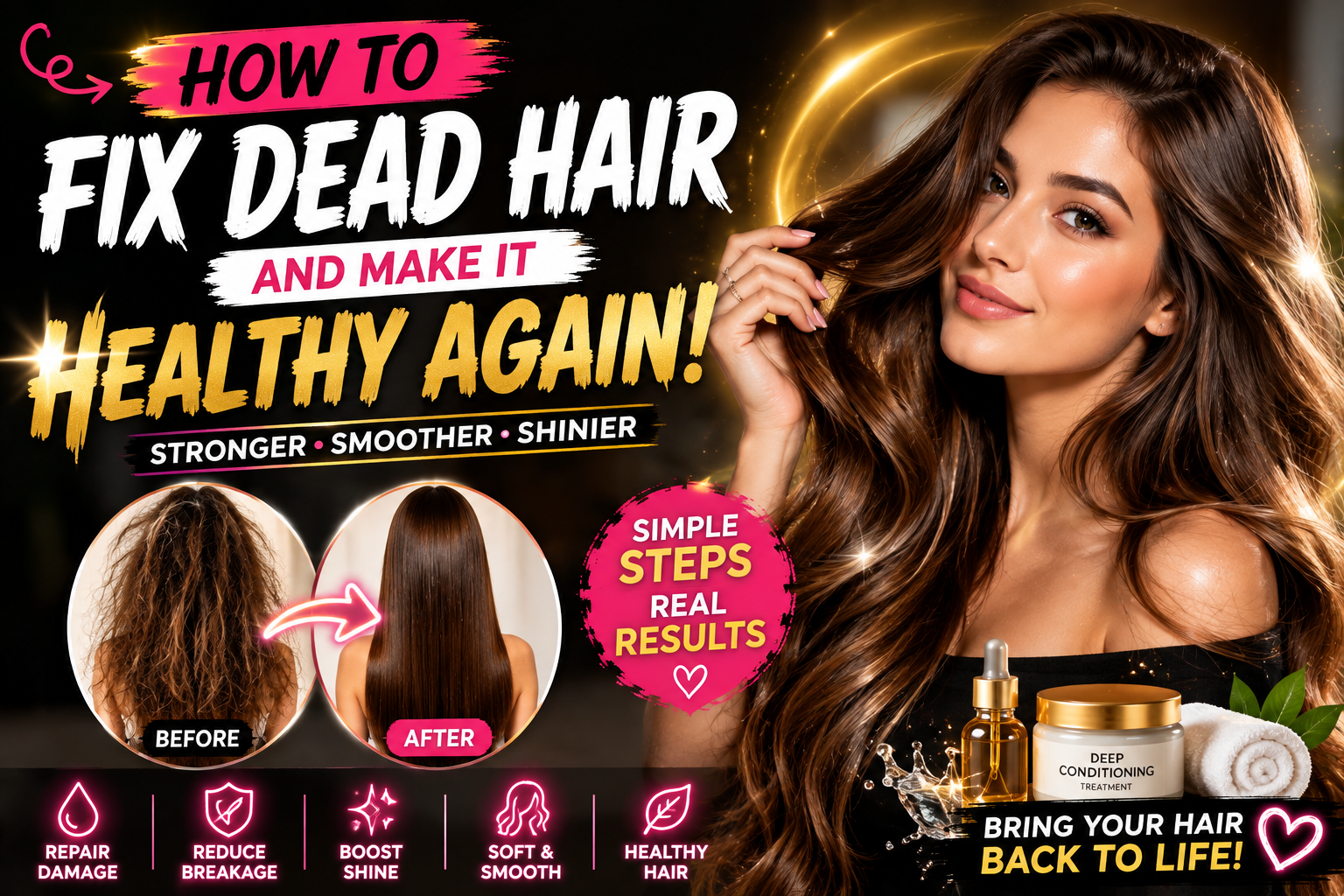
How to Fix Dead Hair: 10 Easy Ways to Repair Dry, Damaged Hair
Dry, rough, frizzy, brittle hair can make you feel like your hair has completely lost its life. Maybe your ends look like straw, your hair tangles the second you brush it, or your once-soft strands now feel rough and dull. If that sounds familiar, you may be wondering how to fix dead hair and get your hair looking healthy again.
The good news is that damaged hair can often be made noticeably softer, smoother, shinier, and easier to manage with the right routine. However, there is an important distinction: the visible hair shaft is made of keratin and is not living tissue. That means a severely damaged strand cannot literally heal itself like skin does.
What you can do is improve the condition and appearance of the hair, protect the healthier sections, reduce breakage, and remove severely split ends when necessary.
Heat styling, bleaching, coloring, chemical treatments, excessive brushing, friction, and harsh hair-care habits can all contribute to dryness and breakage. The American Academy of Dermatology recommends reducing damaging habits and using gentle hair-care techniques to help prevent additional damage.
So, if your hair looks “dead,” don’t panic. Start with the basics and give your hair time to recover from the damage.
What Does “Dead Hair” Actually Mean?
When people say their hair is “dead,” they usually mean that their hair looks or feels extremely dry, damaged, brittle, dull, or rough.
Common signs include:
- Dry or straw-like texture
- Frizzy strands
- Dull-looking hair
- Split ends
- Excessive tangling
- Hair that breaks easily
- Rough ends
- Lack of softness
- Difficulty styling
- Increased flyaways
- Uneven or damaged-looking ends
The problem is often most noticeable toward the ends because the ends are the oldest part of the hair and have experienced more washing, brushing, sunlight, styling, and chemical processing.
If your hair has been repeatedly exposed to high heat or chemical treatments, the outer cuticle can become damaged. Once the protective structure becomes compromised, the hair may become more vulnerable to dryness, tangling, and breakage.

One of the first steps in learning how to fix dead hair is changing the way you wash it.
Shampoo is important because it removes oil, sweat, dirt, and product buildup from your scalp. However, aggressive washing and scrubbing the lengths of your hair can contribute to dryness.
Instead of rubbing shampoo throughout your hair, focus mainly on your scalp and roots. As you rinse, allow the shampoo to travel through the lengths naturally.
The American Academy of Dermatology recommends gently massaging shampoo into the scalp rather than aggressively rubbing the hair itself.
Choose a shampoo according to your hair type. If your hair is particularly dry or chemically treated, look for a gentle, moisturizing formula designed for dry or damaged hair.
You don’t necessarily need to wash your hair every day. Your ideal washing schedule depends on your scalp, hair texture, oil production, lifestyle, and styling routine.
2. How to Fix Dry and Damaged Hair With Conditioner
If your hair feels rough, conditioner should become a regular part of your routine.
Conditioner helps make hair easier to detangle and manage. It can also reduce the friction that occurs when you’re brushing or combing your strands.
After shampooing, apply conditioner mainly through the lengths and ends.
If your hair is fine or straight, you may prefer concentrating conditioner on the ends so your roots don’t become weighed down. If your hair is dry, curly, or thick, you may benefit from applying conditioner more generously through the lengths.
Dermatologists recommend using conditioner after washing because it helps moisturize and detangle hair.
Simple routine:
- Shampoo your scalp.
- Rinse thoroughly.
- Apply conditioner.
- Concentrate on dry areas and ends.
- Let it sit according to the product directions.
- Rinse gently.
Consistency matters more than using a huge amount of product.
Best Deep Conditioning Treatment for Dry, Damaged Hair
Deep conditioning is one of the easiest ways to make dry, damaged hair feel softer and more manageable. A good deep conditioner can add moisture, reduce the rough feeling of dry strands, and make hair easier to detangle. It can be especially helpful when your hair has been exposed to frequent heat styling, coloring, bleaching, or other habits that leave it feeling brittle.
However, deep conditioning is not a magic fix for severely damaged hair. It can improve the look and feel of the hair, but extremely split or broken ends may still need to be trimmed. The goal is to condition the hair while also reducing the habits that caused the damage in the first place.
How Often Should You Deep Condition Damaged Hair?
For many people, once a week is a good starting point. If your hair is extremely dry or frequently exposed to heat and chemical treatments, you may feel that it needs conditioning more often. On the other hand, fine hair may become weighed down if you use rich treatments too frequently.
Pay attention to how your hair feels after each treatment. If it feels soft, smooth, and easy to manage, your routine is probably working well. When your strands start feeling heavy or coated, reduce the amount or frequency.
Consistency matters more than using a large amount of product. A simple weekly treatment can be more useful than constantly switching between different masks.
How to Apply a Deep Conditioner for Dry Hair
Start by washing your hair gently with a shampoo that suits your hair type. After rinsing, remove excess water so your hair is damp rather than soaking wet.
Apply the deep conditioner through the mid-lengths and ends. These areas are usually older and more exposed to styling damage. If your scalp tends to become oily, avoid applying a heavy mask directly to the roots unless the product specifically recommends it.
Use your fingers or a wide-tooth comb to distribute the treatment gently. Avoid pulling through knots because fragile hair can break more easily when handled roughly. Let the product sit for the amount of time recommended on the label, then rinse thoroughly.
What to Look for in a Hair Repair Treatment
When choosing a treatment for damaged hair, consider what your hair actually needs. A moisturizing mask may be a better choice when your strands feel dry and rough, while a strengthening or repair-focused formula may be useful for hair that feels weak or breaks easily.
You can also look for products designed for color-treated, chemically processed, curly, fine, or thick hair. Choosing a formula made for your hair type can help you avoid using a product that is too heavy or not conditioning enough.
Remember that an expensive product isn’t automatically better. Look for a formula that works well with your hair and fits comfortably into your regular routine.

A rinse-out conditioner isn’t always enough for severely dry hair.
A leave-in conditioner can provide additional conditioning between washing and styling. It can also make your hair easier to comb and help reduce frizz and tangling.
The American Academy of Dermatology notes that leave-in conditioners can be useful for dry, brittle, curly, long, color-treated, or heat-styled hair.
For best results, apply a small amount to damp hair, concentrating on the mid-lengths and ends.
Avoid applying excessive amounts. Too much product can make fine hair look greasy or weighed down.
A simple approach is:
Wash → condition → gently towel dry → apply leave-in conditioner → gently detangle → style.

If you regularly use a flat iron, curling iron, hot comb, or blow dryer, your styling routine may be contributing to the damage.
You don’t necessarily have to give up heat styling forever. Instead, reduce how frequently you use it and lower the temperature whenever possible.
Try these changes:
- Let your hair partially air-dry.
- Use the lowest effective heat setting.
- Use a heat protectant before hot styling.
- Avoid repeatedly passing a flat iron over the same section.
- Give your hair heat-free days.
- Don’t use excessive heat on already fragile ends.
The AAD recommends limiting heat styling and using low or medium temperatures because excessive heat can damage hair.
If your ends are already severely damaged, taking a break from hot tools can make a noticeable difference in how your hair behaves.
6. How to Prevent Breakage in Wet, Damaged Hair
Wet hair requires extra care.
Aggressively brushing or pulling through wet tangles can cause unnecessary breakage. For many hair types, a wide-tooth comb is a better option.
If your hair is straight, you can allow it to partially dry before gently combing. For tightly curled or textured hair, detangling while damp and conditioned may be more appropriate.
Start at the ends and gradually work your way upward rather than dragging a brush from the roots to the ends.
The AAD recommends minimizing rough handling and using gentle detangling techniques to reduce damage.
7. How to Protect Dry Hair From Towel Damage
Here’s a small habit that can make a big difference: don’t aggressively rub your hair dry.
Instead, gently wrap your hair in a towel or soft T-shirt and allow it to absorb excess water.
You can also use a microfiber towel if you prefer.
Why does this matter?
Rough towel drying creates friction, and fragile hair is more susceptible to breakage.
Instead of:
Rub → twist → pull
Try:
Wrap → gently press → release
It’s a simple change that takes almost no extra time.
8. How to Fix Dead Hair and Split Ends With a Trim
This is one of the most important things to understand about how to fix dead hair.
If the ends are severely split, no conditioner can permanently turn those damaged ends back into completely new hair.
A trim can remove the most damaged sections and give your hairstyle a cleaner, healthier-looking appearance.
You don’t necessarily need a dramatic haircut. Talk to your stylist about removing the most damaged ends while keeping as much length as possible.
If you’re trying to grow your hair longer, regular small trims can be easier emotionally than waiting until severe breakage forces you to cut off more length.
Professional hair-care guidance also emphasizes trimming severely split ends because once an end is split, removing the damaged portion is the practical way to stop that particular split from remaining in the hair.
9. How to Repair Hair Damaged by Bleach and Chemicals
Coloring can be fun, but repeated chemical processing can leave hair dry and fragile.
Bleaching is particularly demanding on the hair because it changes the hair’s structure to remove pigment.
If your hair is already extremely dry or breaking, consider taking a break from:
- Bleaching
- Frequent permanent coloring
- Relaxers
- Perms
- Chemical straightening
- Repeated color corrections
If you want a chemical service, choose an experienced professional who can assess the condition of your hair before treating it.
The AAD advises taking care with coloring, perming, and relaxing because these processes can contribute to hair damage.

Your hair also has to deal with the environment.
Sun exposure, dry weather, wind, and chlorinated water can contribute to dryness and roughness. If you spend a lot of time outdoors, consider wearing a hat when appropriate.
If you’re swimming, rinse your hair afterward and follow with appropriate cleansing and conditioning.
The AAD recommends rinsing hair promptly after swimming and using suitable shampoo and conditioner when needed.
If you’re spending a long day outdoors, a wide-brimmed hat can also help protect your hair and scalp from direct sun exposure.
Best Hair Care Routine to Fix Dead Hair
If your hair currently feels dry, brittle, and lifeless, you don’t need a complicated 20-step routine.
Try this simple routine:
Wash Day
Start with a gentle shampoo: Clean your scalp without aggressively scrubbing the lengths of your hair.
Follow with a moisturizing conditioner: Apply it mainly to the mid-lengths and ends, where dryness is usually more noticeable.
Detangle with care: Use a wide-tooth comb and gently work through knots, starting at the ends and moving upward.
Rinse gently: Remove the conditioner without rubbing or pulling your hair.
Dry without rough handling: Wrap your hair in a soft T-shirt or towel and gently press out excess water.
Add leave-in conditioner: Apply a small amount to damp hair, focusing on the driest areas and ends.
Let it air-dry when possible: Giving your hair a break from hot tools can help reduce additional heat damage.
Use heat protection when styling: If you need a blow dryer, flat iron, or curling tool, apply a heat protectant and choose a lower temperature.
Once a Week
Add a deep-conditioning treatment if your hair needs additional moisture and manageability.
Every Few Weeks or As Needed
Evaluate your ends. If you see severe splitting or repeated breakage, consider a trim.
Best Ingredients for Dry and Damaged Hair
When shopping for products for dry or damaged hair, don’t get distracted by marketing alone.
Depending on your hair type and needs, useful product categories can include:
- Moisturizing conditioners
- Deep-conditioning masks
- Leave-in conditioners
- Detanglers
- Heat protectants
- Lightweight hair oils
- Smoothing serums
- Repair-focused treatments
A leave-in conditioner may be particularly helpful when your hair is dry, tangled, frizzy, or heat-styled.
Remember that the best product isn’t necessarily the most expensive one. Your hair’s texture, condition, and styling habits matter more than the price tag.
Can Hair Oils Help Fix Dry and Damaged Hair
Hair oils can make dry hair feel smoother and look shinier, especially when used appropriately.
However, oil isn’t a magical cure for severely damaged hair.
A small amount can be applied to the mid-lengths and ends to improve the feel and appearance of dry strands. Start with a tiny amount because using too much can leave the hair heavy or greasy.
If you have a sensitive or irritated scalp, avoid randomly layering oils onto the scalp without knowing whether the product is suitable for you.
The main goal is still to reduce damage and maintain a consistent conditioning routine.
Common Mistakes That Cause More Hair Damage
If you’re trying to learn how to fix dead hair, avoiding additional damage is just as important as adding treatments.
Brushing Too Aggressively
You don’t need to brush your hair 100 times a day. Excessive brushing can contribute to breakage and split ends.
Using High Heat Every Day
Daily flat ironing or curling can make already fragile hair even more vulnerable.
Washing the Lengths Aggressively
Your scalp needs cleansing, but aggressively scrubbing the lengths isn’t necessary.
Wearing Tight Hairstyles Constantly
Repeatedly wearing very tight ponytails, buns, braids, cornrows, or extensions can place tension on the hair.
Skipping Conditioner
Dry hair generally benefits from consistent conditioning.
Doing Too Many Treatments at Once
Using five different masks, oils, treatments, and styling products at the same time can make it difficult to understand what is actually helping.
Keep your routine simple and consistent.
Can You Really Repair Dead Hair?
This is where expectations matter.
You can improve the look and feel of damaged hair, but you cannot turn severely destroyed hair back into completely untouched, virgin hair.
Conditioners, masks, leave-ins, oils, and repair treatments can make hair feel smoother, reduce friction, improve manageability, and temporarily improve the appearance of damaged strands.
But severely split or broken areas may ultimately need to be trimmed.
Think about it this way:
The goal isn’t to magically resurrect damaged strands. The goal is to protect what you have, improve its appearance, prevent more damage, and grow healthier hair from the scalp.
That’s a much more realistic—and achievable—approach.
When to See a Dermatologist for Damaged Hair
Dryness isn’t always just a hair-care problem.
If changing your routine doesn’t improve the condition of your hair, or if you also notice significant hair shedding, thinning, bald patches, scalp pain, itching, redness, or other unusual symptoms, consider talking with a board-certified dermatologist.
The AAD notes that hair loss can have many causes, and identifying the underlying cause is important for appropriate treatment.
Don’t assume that every case of brittle or thinning hair can be fixed with an oil or hair mask.
Sometimes the hair itself isn’t the only issue.
How to Fix Dead Hair: Final Tips
Learning how to fix dead hair doesn’t require an expensive shelf full of products.
Start with the fundamentals: wash your scalp gently, condition consistently, use a deep-conditioning treatment when appropriate, protect your hair from excessive heat, detangle carefully, avoid rough towel drying, limit harsh chemical processing, and trim severely split ends.
Most importantly, give your routine time.
Hair doesn’t change overnight, and severely damaged ends cannot become brand-new hair. But by reducing the habits that cause damage and consistently protecting your strands, you can help your hair look smoother, softer, shinier, and healthier.
The biggest secret isn’t one miracle product.
It’s consistency.
Treat your hair gently today, and you’ll be giving your future hair a much better chance to look and feel its best.
FAQ: How to Fix Dead Hair
Can dead hair become healthy again?
Damaged hair can often be made to look and feel healthier with conditioning, gentle care, and reduced damage. However, severely damaged hair cannot biologically heal itself because the visible hair shaft is not living tissue.
What is the fastest way to fix dead hair?
Start by reducing the cause of damage. Limit heat and chemical processing, use conditioner after washing, add a suitable deep-conditioning treatment, detangle gently, and trim severely split ends.
How often should I deep condition damaged hair?
For many people, once a week is a reasonable starting point. Your ideal frequency depends on your hair type, condition, and the specific product instructions.
Should I cut dead ends?
If your ends are severely split or breaking, a trim can remove the damaged portion and improve the appearance of your hair. There is no product that can permanently fuse a severely split end back into completely undamaged hair.
Is heat causing my hair to look dead?
It can. Excessive heat from blow dryers, flat irons, curling irons, and hot combs can contribute to hair damage. Lowering the temperature and reducing how often you use hot tools can help minimize additional damage.
Can I fix dead hair naturally?
You can improve dry and damaged hair with gentle habits and simple conditioning care. The most important thing is not whether a remedy is “natural,” but whether it helps condition the hair without causing additional damage.

One Comment