
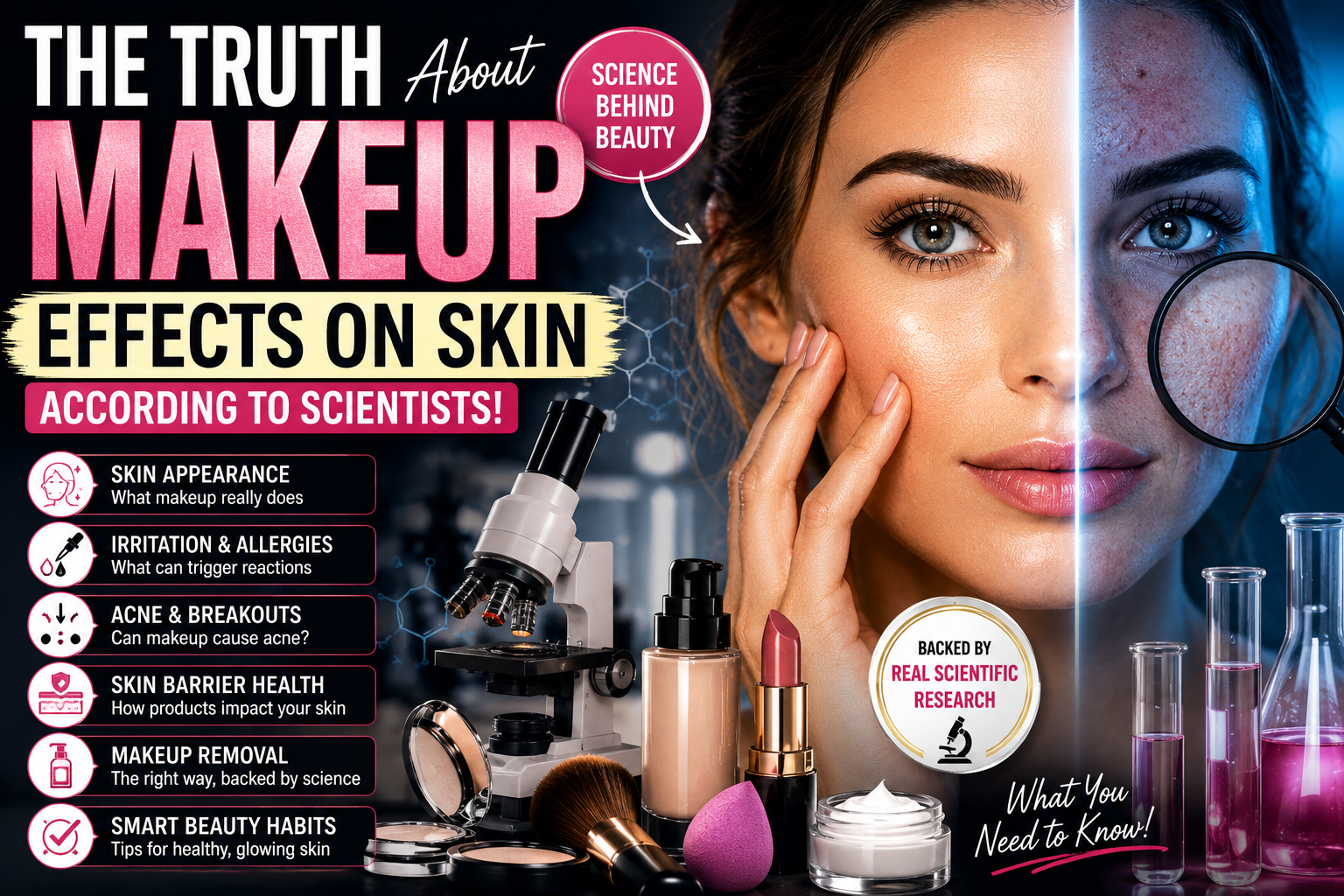
Makeup Effects on Skin: Scientists Reveal the Surprising Truth
The makeup effects on skin may be more complicated than you think. Makeup can instantly make your complexion look smoother, brighter, and more even, but what happens underneath the makeup? Scientists and dermatology researchers have studied cosmetics, skin reactions, makeup removal, and the way cosmetics influence facial appearance. Their findings suggest that makeup is not simply “good” or “bad” for your skin. The results can depend on the ingredients, your skin type, how long you wear the product, and how you remove it.
For millions of people, makeup is an everyday part of getting ready for work, school, special occasions, or a night out. Foundation, concealer, blush, bronzer, mascara, and lipstick can completely transform a beauty look in minutes. But beauty is more than what you see in the mirror.
Scientific research gives us a better way to understand what cosmetics can actually do. Some products can improve the appearance of skin without changing its underlying structure, while certain ingredients may cause irritation or allergic reactions in sensitive individuals.
So, what do scientists really say about makeup and your skin?
Makeup Effects on Skin: What Scientists Have Discovered
One of the most interesting areas of research involves the way makeup changes the appearance of facial skin.
Foundation and concealer are designed to create a more uniform complexion. They can reduce the visual appearance of discoloration, redness, dark spots, and other imperfections. But researchers have discovered that makeup can influence how people perceive the entire face—not simply cover imperfections.
A study published in Vision Research examined how makeup applied to different facial features influenced perceptions of skin evenness. Researchers found that makeup could make faces appear to have more even-looking skin, even when makeup was not directly applied to the skin itself.
This suggests that the human eye does not judge skin completely independently. The color and appearance of surrounding facial features can influence how the complexion is perceived.
That may explain why a complete makeup look can make the skin appear more polished and balanced without completely covering every area.

This distinction is important when discussing the makeup effects on skin.
When foundation makes your complexion look smoother, it does not necessarily mean that your actual skin texture has changed. Makeup can temporarily create a smoother appearance by adding pigment, controlling shine, evening out color, or reflecting light.
In simple terms, makeup can change what you see without changing the biological structure underneath.
That is why foundation can make pores appear less noticeable or concealer can make a blemish look less visible, while the underlying skin remains essentially the same.
Can Makeup Cause Skin Irritation?
Yes, certain cosmetics can cause irritation or allergic reactions in some people.
Researchers have documented cosmetic-related reactions that can include redness, itching, burning, swelling, irritation, and allergic contact dermatitis. However, experiencing a reaction does not mean that every makeup product is harmful.
Your individual response can depend on several factors.
These may include:
- Your skin sensitivity
- The ingredients in the product
- How frequently you use it
- How long the product stays on your skin
- Your existing skin condition
- How aggressively you remove makeup
- Whether the cosmetic has become contaminated
This is why one person can comfortably wear the same foundation every day while another person may experience redness or discomfort.
The important lesson is to pay attention to your own skin rather than assuming that every cosmetic works the same way for everyone.
Makeup Effects on Skin Depend on the Ingredients
The word “makeup” covers a huge range of products.
Foundation, concealer, mascara, eyeshadow, lipstick, blush, bronzer, setting spray, and powder can all contain different ingredients and formulations.
Cosmetics may contain pigments, fragrances, preservatives, surfactants, emollients, oils, and other compounds designed to improve texture, color, stability, or performance.
Some people may be sensitive to particular ingredients.
For example, fragrances, preservatives, and certain colorants have been associated with unwanted cosmetic reactions in susceptible individuals. This does not mean that everyone should avoid these ingredients. Instead, it shows why individual tolerance is important.
If a particular cosmetic repeatedly causes burning, itching, redness, or discomfort, it may not be the right product for your skin.
A popular product is not automatically the best product for everyone.
Does Makeup Cause Acne?
This is one of the most common questions surrounding the makeup effects on skin.
The short answer is: it depends.
Wearing makeup does not automatically mean that you will develop acne. Many people use foundation and concealer regularly without experiencing breakouts.
However, some individuals may notice that certain products appear to contribute to clogged pores or breakouts. Other factors can also be involved, including sweat, oil, touching your face, product buildup, and inadequate cleansing.
Instead of blaming all makeup, look for patterns.
If you notice repeated breakouts after introducing a particular foundation, concealer, or other product, consider stopping that product and observing how your skin responds.
It is also important to keep makeup tools clean and avoid using products that are old, contaminated, or significantly changed in smell or texture.

What Happens When You Leave Makeup on Too Long?
Modern cosmetics are often designed to last for many hours. Long-wear foundation, waterproof mascara, and transfer-resistant lip products can remain on the skin throughout a busy day.
Wearing makeup for a full workday does not automatically mean that your skin is being damaged.
However, longer wear means longer contact between your skin and the cosmetic product. If your skin is sensitive to an ingredient, extended exposure may become uncomfortable.
Makeup can also mix with sweat and natural skin oils throughout the day.
This is why removing makeup at the end of the day is an important beauty habit.
The goal is not to panic about wearing makeup for several hours. Instead, understand how your skin responds and develop a gentle cleansing routine that works for you.
Scientists Have Studied Makeup Removal Too
Interestingly, some of the makeup effects on skin may be connected to what happens after you finish wearing makeup.
Makeup removal sounds simple, but many people use too much pressure when cleansing their face. Repeated rubbing can be especially uncomfortable for sensitive or reactive skin.
A clinical study involving people with mild atopic dermatitis examined makeup removal and cleansing. Researchers found that reducing the amount of rubbing required during makeup removal was associated with improvements in symptoms such as dryness, scaling, redness, itching, and irritation.
This is an important reminder that clean skin does not require aggressive scrubbing.
If a makeup product is difficult to remove, consider using a suitable makeup remover or cleansing product that can break it down more easily.
Why Gentle Makeup Removal Matters
Your skin has a protective outer barrier. Excessive friction can make cleansing uncomfortable, particularly when the skin is already sensitive.
Instead of rubbing your eyes or cheeks repeatedly, allow your makeup remover to dissolve the product.
For eye makeup, gently hold a suitable remover against the closed eyelid for a few seconds before wiping. For foundation, use gentle movements rather than repeatedly scrubbing the same area.
A simple rule is:
Dissolve first. Wipe gently. Cleanse without overdoing it.
Makeup Effects on Skin and the Skin Barrier
The skin barrier is the outer protective layer of the skin. It helps reduce water loss and provides protection against the outside environment.
Not every cosmetic affects the skin barrier in the same way.
The formulation matters.
Research into cosmetic ingredients has shown that certain surfactants can interact with components of the outer skin layer and may contribute to irritation depending on the substance and exposure.
This is one reason you should not judge a cosmetic simply because it is labeled “natural,” “clean,” “luxury,” or “drugstore.”
A high price does not automatically make a product better for your skin.
Likewise, a lower-priced product is not automatically bad.
The formulation and your individual response matter more.

What About Sensitive Skin?
People with sensitive skin may need to pay extra attention to the makeup effects on skin.
If your skin frequently becomes red, itchy, dry, or uncomfortable after applying cosmetics, experiment carefully with your routine.
Consider introducing one new product at a time rather than changing your entire makeup collection at once. This makes it easier to identify which product may be causing a problem.
You can also consider choosing simpler formulations and avoiding products that have repeatedly caused discomfort.
Helpful habits include:
- Introduce new makeup products gradually.
- Pay attention to burning, itching, or redness.
- Remove makeup gently.
- Keep makeup brushes clean.
- Avoid sharing eye and lip products.
- Replace products when they are no longer in good condition.
- Stop using products that repeatedly cause reactions.
If a reaction is severe, persistent, or worsening, consider speaking with a dermatologist.
Does Makeup Make Your Skin Look Better?
Scientifically, yes—makeup can change how people perceive your complexion.
This is one of the most fascinating parts of the science behind beauty.
Foundation can create a more consistent-looking skin tone. Concealer can make discoloration less noticeable. Blush can add warmth and dimension. Bronzer can create definition. Highlighter can make certain areas appear more reflective.
These are appearance effects.
They can be dramatic, but they do not necessarily mean that the makeup has changed the actual biology of your skin.
This distinction is especially important when looking at beauty advertisements and social media.
A product can make skin appear flawless in a photograph without actually treating pores, acne, pigmentation, or other underlying skin concerns.
Makeup Can Create the Appearance of Smoother Skin
The makeup effects on skin appearance are often immediate.
A good foundation can visually blur uneven color. Powder can reduce shine. Concealer can soften the appearance of dark circles. Highlighter can create the appearance of light reflecting from the complexion.
The result can look impressive.
But it is still primarily a cosmetic effect.
If you want to improve your actual skin health, makeup should work alongside—not replace—a sensible skincare routine.
Does Wearing Makeup Age Your Skin?
This is another topic where online beauty claims can become exaggerated.
There is no simple scientific rule saying that wearing makeup automatically causes your skin to age faster.
Visible skin aging is influenced by many factors, and makeup should not be treated as the single cause.
However, poor beauty habits may contribute to temporary irritation or discomfort.
For example, repeatedly using a product that irritates your skin or aggressively rubbing your face during makeup removal is not a good habit.
Instead of worrying that every foundation is secretly aging your skin, focus on basic skin care.
Protect your skin from excessive sun exposure, cleanse gently, moisturize when appropriate, and use cosmetics that your skin tolerates well.
Makeup and Sun Exposure
Makeup and sunscreen are not necessarily the same thing.
Some makeup products contain SPF, but the amount of makeup people typically apply may not provide the same level of sun protection as a dedicated sunscreen product.
If protecting your skin from UV exposure is important, consider using a broad-spectrum sunscreen as part of your skincare routine.
You can then apply your makeup over it.
Think of sunscreen as skin protection and makeup as cosmetic enhancement.
This approach allows you to enjoy makeup while still prioritizing everyday skin care.

Can Makeup Be Good for Your Skin?
Some cosmetic products contain ingredients that can provide more than color and coverage.
Certain complexion products may contain moisturizing or conditioning ingredients. However, whether a particular product benefits your skin depends on its complete formulation and how your skin responds to it.
A foundation containing skincare ingredients should not automatically be considered a replacement for your regular skincare products.
Makeup and skincare have different primary purposes.
A moisturizer is generally designed to support skin hydration and comfort, while foundation is primarily designed to improve the appearance of the complexion.
Some products may combine cosmetic and skincare functions, but they should not automatically be treated as interchangeable.
7 Smart Habits for Healthier Makeup Use
Understanding the makeup effects on skin does not mean you need to stop wearing makeup.
Instead, a few smart habits can help you enjoy cosmetics while taking better care of your skin.
1. Remove Makeup Before Bed
Make makeup removal part of your evening routine.
You do not need to scrub your face aggressively. Use a gentle method that effectively removes the products you have worn.
2. Do Not Ignore Irritation
Burning, itching, persistent redness, or swelling should not simply be ignored.
If a product repeatedly causes a reaction, stop using it and consider getting professional advice if symptoms continue.
3. Keep Makeup Brushes Clean
Brushes repeatedly come into contact with makeup, natural oils, and your skin.
Regular cleaning helps reduce product buildup and keeps your beauty tools fresher.
4. Avoid Sharing Makeup
Especially with eye and lip products, sharing cosmetics can increase the possibility of transferring microorganisms.
Keep personal makeup products personal.
5. Check the Condition of Your Products
If a cosmetic changes its smell, color, texture, or consistency, consider replacing it.
Do not keep using an old product simply because there is still some left.
6. Be Gentle Around the Eyes
The skin around your eyes is delicate.
Avoid aggressive rubbing when removing mascara, eyeliner, or eyeshadow. Give the remover time to dissolve the product before gently wiping.
7. Listen to Your Skin
Your skin can give you useful clues.
If one foundation feels comfortable while another repeatedly causes irritation, you do not need to continue using the irritating product just because it is popular or trending.
The Bottom Line on Makeup Effects on Skin
So, what are the real makeup effects on skin?
The science does not support a simple statement that all makeup is bad for your skin.
Research shows that cosmetics can significantly influence the way people perceive facial appearance and skin evenness. At the same time, some cosmetic products or ingredients can cause irritation or allergic reactions in susceptible people.
The way makeup is removed also matters. Excessive rubbing may be particularly uncomfortable for people with sensitive or reactive skin.
The best approach is balance.
You can enjoy foundation, concealer, blush, mascara, lipstick, and all the other products you love while still taking care of your skin.
Choose products thoughtfully. Pay attention to ingredients when necessary. Do not ignore repeated irritation. Keep your makeup tools clean. Remove cosmetics gently at the end of the day. And remember that makeup is designed primarily to change appearance—not necessarily to treat the underlying skin.
Frequently Asked Questions
Does makeup damage your skin?
Not necessarily. The effects depend on the product, ingredients, frequency of use, individual sensitivity, and cleansing habits. Some people may experience irritation or allergic reactions to particular cosmetics.
Can makeup cause acne?
Certain products may contribute to breakouts in some people, but makeup does not automatically cause acne. Skin type, product formulation, sweat, oil, hygiene, and other factors can also play a role.
Should I remove makeup before sleeping?
Yes. Removing makeup at the end of the day is a sensible beauty habit, especially when you have worn foundation, eye makeup, or long-wear products.
Can makeup make skin look more even?
Yes. Scientific research has found that makeup can influence perceived skin evenness and overall facial appearance.
Is expensive makeup better for your skin?
Not necessarily. Price does not automatically determine whether a product will suit your skin. Formulation and individual tolerance are more important.
What should I do if makeup causes burning or itching?
Stop using the product that appears to be causing the reaction. If symptoms are significant, persistent, or worsening, consider speaking with a dermatologist.
Final Thoughts
The science behind makeup is more fascinating than simply asking whether cosmetics are good or bad.
The makeup effects on skin can involve both appearance and skin comfort. Makeup can create a smoother, more even-looking complexion, while certain ingredients or habits may cause irritation for some people.
The good news is that you do not have to choose between beautiful makeup and healthy-looking skin.
The smarter approach is to understand your products, pay attention to how your skin responds, remove makeup gently, keep your tools clean, and maintain a basic skincare routine.
Makeup can transform the way your skin looks without necessarily transforming the skin itself.
And that may be the most surprising part of the science: sometimes, the beauty effect is not only about what makeup puts on your skin—it is also about how the human eye perceives the face.




2 Comments