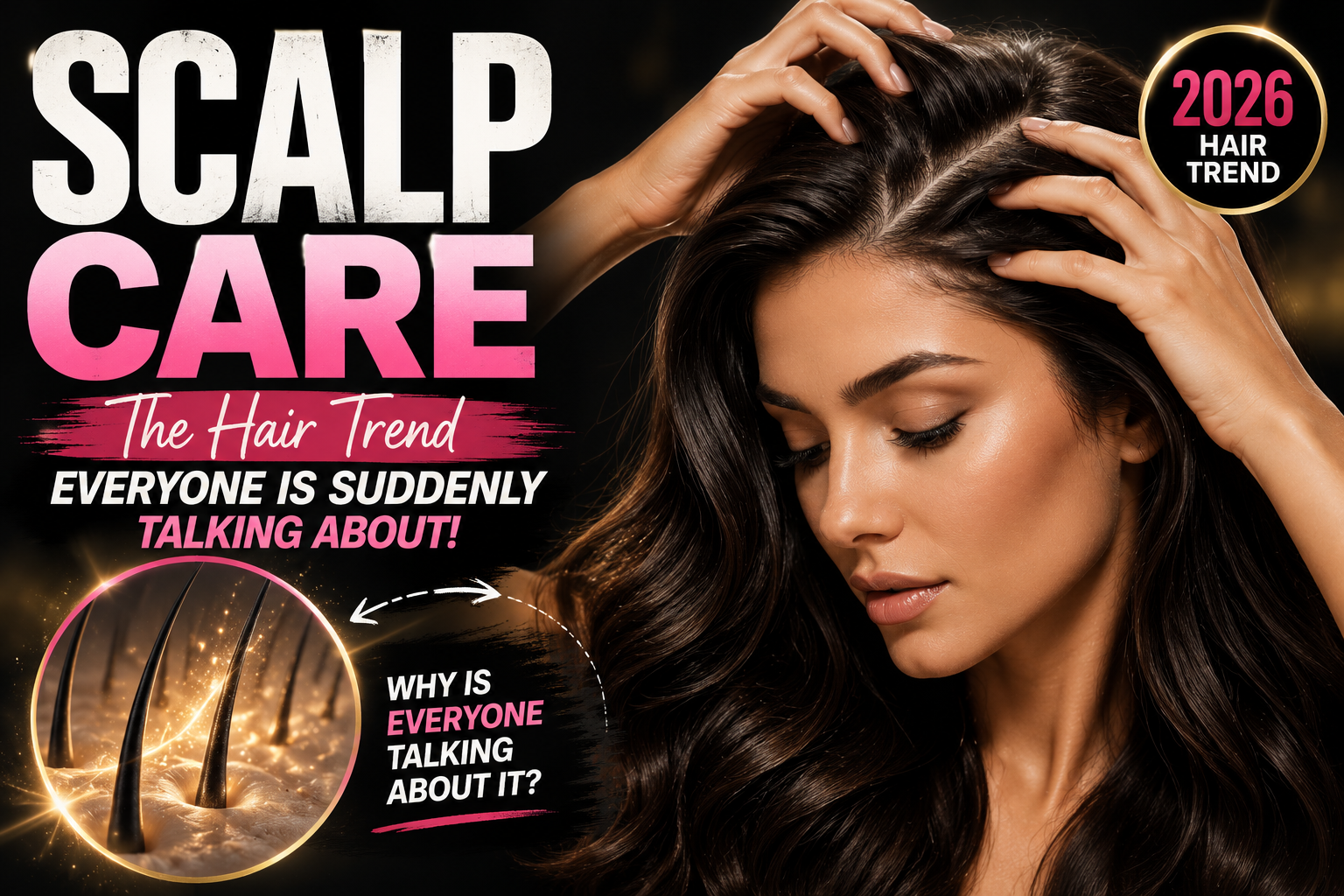
Scalp Care: Why Everyone Is Talking About This 2026 Hair Trend
Scalp care is becoming one of the biggest hair-care trends of 2026. More people are treating their scalp with the same attention they give their skin, focusing on healthy roots, targeted treatments, and better hair-care routines. For years, most hair care routines focused on the strands: shampoo, conditioner, hair masks, oils, and styling products. But in 2026, the beauty conversation is moving closer to the roots.
Scalp care is becoming the new skin care.
Instead of treating the scalp as an afterthought, beauty lovers are giving it the same attention they give their face. Cleansing, exfoliating, moisturizing, massaging, and using targeted scalp treatments are becoming important parts of modern hair care routines.
This shift is often described as the “skinification” of hair care—the idea of treating the scalp more like facial skin and choosing products based on specific scalp needs. Industry reports and beauty coverage are increasingly pointing toward scalp-first routines as a major direction for hair care in 2026.
And there is a simple reason this trend is attracting so much attention: healthy-looking hair starts at the scalp.
What Is Scalp Care?
Scalp care is a hair care approach focused on keeping the skin of your scalp clean, comfortable, balanced, and well cared for.
Just like facial skin can become dry, oily, congested, or sensitive, the scalp can also experience different concerns. Product buildup, excess oil, dryness, flakes, irritation, and sweat can all affect how your scalp feels and how your hair looks.
A scalp-focused routine may include:
- Gentle scalp cleansing
- Scalp exfoliation when appropriate
- Scalp massage
- Lightweight scalp serums
- Moisturizing treatments
- Careful product selection
- Reducing unnecessary buildup
- Protecting the scalp from excessive heat and irritation
The goal isn’t to create a complicated 10-step routine. Instead, the idea is to understand your scalp and give it the type of care it actually needs.
 Why Is Scalp Care Trending in 2026?
The beauty industry is increasingly moving toward preventive and long-term hair health rather than simply making hair look good for a few hours.
Recent industry reporting describes scalp care and hair longevity as major areas of innovation, with the broader hair-care market expected to grow while placing stronger emphasis on scalp health.
At the same time, consumers are becoming more interested in products designed for specific concerns rather than one-size-fits-all hair products.
That means the question is changing from:
“Which shampoo makes my hair look better?”
to:
“What does my scalp actually need?”
That small change could completely transform the way people approach their hair care routine.
Scalp Care Is the New Skin Care
The biggest idea behind this trend is skinification.
Think about your facial skincare routine. You may use a cleanser, exfoliant, serum, moisturizer, and sunscreen because you understand that different products perform different jobs.
The same philosophy is now moving into hair care.
Instead of simply washing your hair and applying conditioner to the ends, you can pay attention to the scalp itself.
Some modern scalp products use skincare-inspired ingredients such as peptides, antioxidants, acids, and other targeted ingredients. The purpose is not necessarily to copy your facial routine exactly, but to apply the same personalized approach to scalp care.
7 Scalp Care Steps to Try in 2026
You don’t need dozens of products to follow this trend. A simple routine can be enough.
1. Start With a Clean Scalp
Cleansing is the foundation of scalp care.
Sweat, oil, styling products, dry shampoo, and environmental residue can accumulate around the scalp. Regular washing can help remove excess oil and buildup.
However, washing more aggressively isn’t automatically better.
If your scalp feels tight, irritated, or unusually dry after washing, your routine may be too harsh.
Choose a shampoo according to your scalp’s needs rather than simply choosing one marketed for a particular hair length or style.
2. Don’t Ignore Scalp Buildup
Product buildup is one reason scalp cleansing has become such a popular part of modern hair care.
Heavy styling products, oils, dry shampoo, and environmental residue can leave the scalp feeling less fresh.
A gentle cleansing routine may be enough for many people. In some cases, an appropriate exfoliating scalp treatment can also be useful.
But more exfoliation does not mean better results.
The scalp is skin, so aggressive scrubbing can cause unnecessary irritation.
A recent Guardian explainer on the scalp-detox trend noted that while “detox” isn’t a medical process, removing buildup can be useful in certain situations, particularly for people dealing with heavy product residue or hard-water buildup.
3. Try a Gentle Scalp Massage
Scalp massage is another easy addition to a hair care routine.
Using your fingertips, gently massage the scalp for a few minutes while washing or applying an appropriate scalp product.
The key word is gentle.
You don’t need to scratch, pull, or aggressively rub your scalp. Your fingertips should move comfortably without causing pain or irritation.
Some people also use scalp massagers, but a tool isn’t essential.
4. Choose Scalp Serums Carefully
Scalp serums are becoming increasingly popular because they allow people to target specific concerns.
Depending on the formula, a scalp serum may be designed for hydration, comfort, oil balance, or the appearance of fuller-looking hair.
The important thing is to read the ingredient list and understand what the product is intended to do.
Don’t assume that an expensive serum will automatically produce dramatic hair growth.
Hair growth and hair loss can have many different causes, and cosmetic products cannot solve every underlying problem.
5. Think About Your Scalp, Not Just Your Hair Type
You may know whether your hair is straight, wavy, curly, coily, dry, or oily.
But your scalp type matters too.
For example, someone can have dry hair ends while having an oily scalp.
Another person may have naturally dry hair and a dry-feeling scalp.
That’s why a single product routine doesn’t work equally well for everyone.
Your hair strands and scalp can have completely different needs.
6. Don’t Overload Your Scalp With Products
One of the biggest mistakes people can make while following a new trend is assuming that more products equal better results.
They don’t.
Layering oils, scrubs, masks, serums, dry shampoo, styling products, and other treatments without understanding how they interact can leave your scalp feeling heavy or irritated.
A better approach is to start simple.
Cleanse → treat your specific concern → protect your hair.
Then add products only when you actually need them.
7. Protect Your Hair From Excessive Damage
Scalp care is only one part of healthy-looking hair.
Your strands also need protection.
Frequent high-heat styling, aggressive brushing, tight hairstyles, repeated chemical processing, and rough handling can contribute to breakage and damage.
Modern hair care is increasingly focused on long-term hair health rather than temporary shine.
Recent 2026 coverage also highlights a broader move toward hair health, with stylists and beauty brands emphasizing consistent routines and damage prevention.
Can Scalp Care Help Hair Growth?
This is where it is important to separate beauty trends from medical claims.
A healthy scalp is an important part of maintaining a healthy hair-care environment, but scalp care products should not be presented as guaranteed hair-growth treatments.
Hair shedding and hair loss can have many causes, including genetics, hormones, nutritional problems, stress, medications, and medical conditions.
If someone is experiencing sudden, severe, or persistent hair loss, talking with a dermatologist or other qualified healthcare professional is more appropriate than relying only on cosmetic products.
The good news is that scalp care can still be a valuable part of a broader hair-care routine.
The Rise of “Hair Longevity”
One of the most interesting developments in 2026 hair care is the idea of hair longevity.
Instead of waiting until hair becomes severely damaged and then trying to repair it, the industry is increasingly focusing on maintaining hair quality over time.
That means protecting the scalp, minimizing unnecessary damage, maintaining moisture, reducing breakage, and choosing products more intentionally.
Industry reporting specifically identifies longevity as an emerging focus within hair care.
This is an interesting shift because it makes hair care feel less like a quick beauty fix and more like a long-term investment.
The “Scalp-First” Hair Care Routine
Want to try the 2026 trend without buying an entire shelf of products?
Start with a simple scalp-first routine.
Step 1: Cleanse
Use a shampoo appropriate for your scalp and hair needs.
Step 2: Assess
After washing, pay attention to how your scalp feels.
Does it feel comfortable? Dry? Oily? Tight? Irritated?
Step 3: Treat
If you need a scalp treatment, choose one designed for your specific concern.
Step 4: Massage
Use gentle fingertip movements during your routine if comfortable.
Step 5: Condition the Lengths
Apply conditioner primarily where your hair needs moisture, especially through the mid-lengths and ends.
Step 6: Protect
Reduce unnecessary heat and rough handling.
This simple approach can be much more practical than following every hair-care trend at once.
Who Should Try Scalp Care?
Almost anyone can benefit from paying more attention to their scalp hygiene and hair-care habits.
It can be particularly useful for people who frequently use:
- Dry shampoo
- Styling sprays
- Hair oils
- Gels and creams
- Heat-styling tools
- Hair color
- Heavy styling products
People who regularly sweat during workouts may also pay closer attention to scalp cleansing.
However, if your scalp is painful, severely itchy, inflamed, or developing persistent scaling or sores, don’t assume it is simply a beauty issue. A healthcare professional can help determine what is actually happening.
The Biggest Scalp Care Mistakes to Avoid
The scalp-care trend is exciting, but it can also create confusion.

Here are some common mistakes:
Over-Exfoliating
Using scalp scrubs or exfoliating acids too frequently can irritate the scalp.
Using Too Many Oils
Oil isn’t automatically beneficial for every scalp. Some people may find heavy oils uncomfortable or difficult to remove.
Scratching the Scalp
Aggressive scratching can irritate the skin.
Buying Products Just Because They Are Viral
A viral product isn’t necessarily the right product for your scalp.
Expecting Instant Hair Growth
Healthy hair is a long-term process. Be cautious of products promising dramatic overnight growth.
Is Scalp Care Just Another Beauty Trend?
Not exactly.
The trend may be new to mainstream beauty conversations, but caring for the scalp itself isn’t new.
What’s changing in 2026 is the level of attention being given to the scalp.
Beauty consumers are becoming more interested in targeted products, personalized routines, scalp health, and long-term hair quality.
That is why “scalp-first” care is becoming such a powerful concept.
Recent 2026 beauty coverage has even described scalp care as a growing boom, while major hair-care developments are increasingly incorporating scalp health into product innovation.

Final Thoughts
Scalp care may be one of the biggest hair-care shifts of 2026.
For years, people focused almost entirely on the visible part of their hair. Now, the beauty industry is encouraging consumers to look closer to the roots.
The message is simple:
Don’t just care for your hair. Start caring for your scalp, too.
You don’t need a complicated routine or dozens of expensive products. Start with gentle cleansing, understand your scalp’s needs, avoid unnecessary buildup and irritation, protect your hair from damage, and choose targeted products carefully.
The next era of hair care may not be about doing more.
It may be about understanding your scalp better.
And that is exactly why scalp care is becoming the new skin care trend everyone is talking about in 2026.

2 Comments