
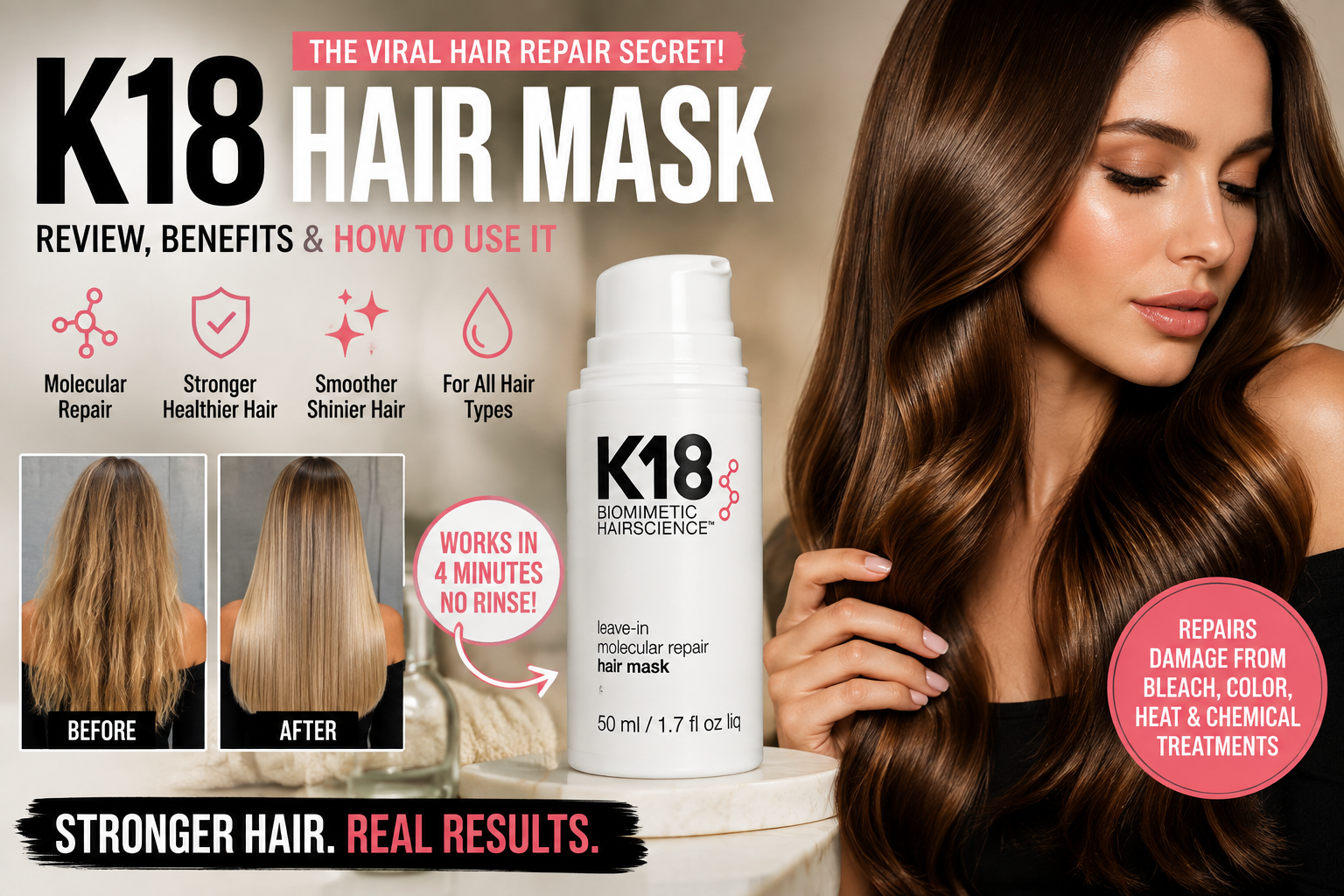
K18 Hair Mask Review: How It Works, Benefits & How to Use It
If your hair has been through bleach, frequent coloring, chemical treatments, or regular heat styling, you may have noticed that it does not feel the way it used to. It can become rough, dry, frizzy, brittle, or difficult to style. That is where K18 Hair Mask has gained so much attention.
K18 is known for its molecular hair-repair approach rather than simply coating damaged strands with a traditional conditioning treatment. Its best-known product, the K18 Leave-In Molecular Repair Hair Mask, uses the brand’s K18PEPTIDE™ technology and is designed to target damage associated with bleach, color, chemical services, and heat.
Unlike a traditional rinse-out hair mask, the K18 mask is left in the hair. The brand’s current instructions recommend shampooing first, skipping conditioner, towel-drying the hair, applying a small amount of the mask, waiting four minutes, and then styling as usual.
But is K18 actually worth the hype? Who should use it? How often should you apply it? And what makes it different from an ordinary deep conditioner?
Let’s break it all down.
What Is K18 Hair Mask?
The K18 Hair Mask is a leave-in molecular repair treatment created for hair that has experienced damage from processes such as bleaching, coloring, chemical services, and heat styling.
The product is powered by K18PEPTIDE™, which K18 describes as a biomimetic peptide designed to reconnect damaged polypeptide chains and disulfide bonds within the hair structure. The goal is to improve the hair’s strength and condition from within rather than simply providing a temporary coating on the outside.
That molecular approach is one of the main reasons K18 stands out in the crowded hair-treatment market.
Traditional conditioners and masks can make hair feel softer and smoother by conditioning the surface. K18 takes a different approach by focusing on the internal structure of the hair fiber.
The brand also describes the formula as pH-optimized and suitable for all hair types. Its official product information states that the mask is vegan, color-safe, and cruelty-free.

How Does K18 Hair Mask Work?
The science behind K18 can sound complicated, but the basic idea is fairly simple.
Your hair contains keratin and other structural components that contribute to its strength and flexibility. Chemical processing and repeated heat exposure can damage the internal structure of the hair.
K18PEPTIDE™ is designed to mimic part of the hair’s natural structure and reconnect damaged polypeptide chains. According to K18, this process also helps reconnect disulfide bonds that can be disrupted by bleaching, coloring, chemical services, and heat.
This is different from simply adding moisture to the hair.
Moisture can help hair feel softer and more manageable, while a repair treatment is intended to address structural damage.
That does not mean one product replaces every other part of a good hair-care routine. Shampoo, conditioner, heat protection, gentle styling, and regular trims can still play important roles.
What Hair Damage Can K18 Help Repair?
K18 is especially interesting if your hair has been exposed to repeated chemical or heat stress.
Bleached Hair
Bleaching can dramatically change the hair fiber. If you regularly lighten your hair, you may notice more dryness, breakage, roughness, or loss of elasticity.
A repair-focused treatment such as K18 may be worth considering as part of a routine designed for chemically processed hair.
Color-Treated Hair
Regular coloring can also contribute to damage, particularly when combined with frequent heat styling or other chemical services.
K18’s official information specifically lists color-related damage among the types of damage its peptide technology is designed to address.
Heat-Damaged Hair
Flat irons, curling irons, blow dryers, and hot styling tools can all contribute to hair damage when used frequently or at excessive temperatures.
K18 can be incorporated into a routine for hair that experiences regular heat styling, although it should not be viewed as permission to use unlimited heat.
A heat protectant and sensible styling temperature still matter.
Dry, Brittle Hair
Hair that feels dry and brittle may benefit from a combination of conditioning and repair-focused care.
However, dryness can have many causes, so K18 is not necessarily the answer to every dry-hair problem.
Your hair may also need moisture, gentle cleansing, and better styling habits.
How to Use K18 Hair Mask Correctly
This is probably the most important part of the article because using K18 correctly matters.
K18’s current official instructions are straightforward.
 Step 1: Shampoo Your Hair
Start with freshly shampooed hair.
K18 recommends applying the mask after shampooing and specifically says not to condition before applying the mask.
If you use a lot of styling products or have significant buildup, K18 recommends clarifying before the mask so the treatment can be applied to clean hair.
Step 2: Do Not Apply Conditioner First
This is one of the biggest differences between K18 and a traditional hair mask.
After shampooing, skip your normal conditioner before applying K18.
The brand recommends this because conditioner may interfere with the mask’s ability to reach the hair’s inner layers.
Step 3: Towel-Dry Your Hair
Your hair should be damp, not dripping wet.
Gently towel-dry your hair after rinsing out your shampoo.
K18 recommends hair that is roughly damp rather than saturated with water because excessive water can dilute the product.
Avoid aggressively rubbing your hair with a towel. A gentle squeeze or soft towel wrap is better for reducing unnecessary friction.
Step 4: Apply a Small Amount
K18 is highly concentrated, so you do not need to cover your hair in a huge amount of product.
The current instructions recommend approximately 1–3 pumps, depending on your hair length and density. Start with less and add more only if necessary.
Apply the product from the ends and work upward toward the roots.
Try to distribute it evenly instead of putting a large amount in one area.
Step 5: Wait Four Minutes
This is the signature part of the K18 routine.
After applying the mask, wait four full minutes.
Do not immediately comb, rinse, or add other styling products during those four minutes. K18 recommends allowing the treatment time to work before continuing with your routine.
Step 6: Do Not Rinse
K18 is a leave-in treatment.
After the four-minute waiting period, you can comb your hair, apply your preferred styling products, and style as usual.
That makes it different from many traditional deep-conditioning masks that require several minutes followed by a thorough rinse.
How Often Should You Use K18 Hair Mask?
K18 recommends using the mask for 4–6 consecutive washes after a salon service and then using it as needed.
You do not necessarily need to use it every time you wash your hair forever.
Once your initial repair routine is complete, you can adjust the frequency depending on your hair’s condition and how much chemical or heat stress it experiences.
For example, someone who regularly bleaches their hair may have different needs from someone who rarely colors or heat-styles their hair.
Pay attention to how your hair feels rather than automatically adding more product.
K18 vs. Traditional Hair Masks
At first glance, K18 may look similar to an ordinary hair mask.
The main difference is the purpose.
A traditional conditioning mask is generally designed to soften, smooth, detangle, and improve the feel of the hair.
K18 is designed around molecular repair using its proprietary peptide technology. The mask is also a leave-in formula, so you do not rinse it out after the four-minute processing time.
That does not make traditional masks useless.
In fact, many people may benefit from both conditioning and repair-focused products at different points in their routine.
Think of them as serving different purposes rather than trying to decide that one category is universally better.
Is K18 Good for All Hair Types?
K18 states that its Molecular Repair Hair Mask works across hair types because its peptide technology operates at the molecular level.
That means people with straight, wavy, curly, and coily hair can potentially use it.
However, hair type is only one part of the equation.
Two people with the same curl pattern can have completely different needs depending on:
- Hair density
- Strand thickness
- Chemical processing
- Color treatments
- Heat styling
- Product buildup
- Moisture balance
- Previous damage
If your hair is relatively healthy and has never been chemically processed or frequently heat styled, you may not need an intensive repair product as often as someone with heavily processed hair.

Can You Use K18 on Curly Hair?
Yes.
K18’s official product information says the mask is designed for all hair types.
For curly hair, the key is applying enough product for even coverage without weighing the hair down.
After the four-minute waiting period, continue with your normal curl routine.
That might include a leave-in conditioner, curl cream, gel, mousse, or another styling product.
Remember that K18 is a repair treatment, not a curl-defining product. You may still need your normal styling products to create the shape and hold you want.

Can You Use K18 on Color-Treated Hair?
This is one of the areas where K18 makes the most sense.
Color and chemical services are among the types of damage the brand specifically targets. K18 also describes the Molecular Repair Hair Mask as color-safe.
If you regularly color or bleach your hair, a repair-focused treatment may be a useful addition to your routine.
Still, healthy color-treated hair needs more than one product.
Use gentle cleansing, protect your hair from excessive heat, avoid unnecessary processing, and follow the instructions provided by your stylist and product manufacturers.
What About K18 Hair Oil?
K18 also offers a molecular repair hair oil designed to smooth and strengthen hair.
According to the brand’s instructions, you can apply 1–3 drops to damp, towel-dried hair before styling or use a small amount on dry hair as a finishing product.
If you use it with the K18 mask, the brand recommends applying the mask first, waiting four minutes, and then applying the oil.
The important lesson is the same: less is more.
Using more product does not automatically mean better results.

Common K18 Mistakes to Avoid
Using Too Much Product
One of the easiest mistakes is assuming that more product will produce better results.
K18 is concentrated, so start with the recommended small amount and increase only when necessary.
Applying It to Dirty, Product-Heavy Hair
If your hair has a lot of buildup, the treatment may not perform as intended.
K18 recommends clarifying first when heavy buildup or mineral and metal buildup is an issue.
Using Conditioner Before K18
The brand specifically recommends skipping conditioner before applying the mask.
Save your normal conditioning steps for later in the routine if needed.
Rinsing It Out
K18’s Molecular Repair Hair Mask is a leave-in product.
After the four-minute wait, you style without rinsing the treatment out.
Skipping the Four-Minute Wait
Four minutes may sound short, but it is an important part of the brand’s application instructions.
Set a timer if necessary.
Expecting It to Replace Heat Protection
K18 is not a substitute for responsible heat styling.
If you use a flat iron, curling iron, or blow dryer, continue using appropriate heat protection and avoid unnecessarily high temperatures.
Is K18 Worth It?
Whether K18 is worth the investment depends largely on your hair.
If your hair is frequently bleached, colored, chemically processed, or heat styled, a specialized repair treatment may make more sense than it would for someone with minimally processed hair.
The product is also relatively different from a conventional rinse-out conditioner because it is built around molecular repair and a short four-minute leave-in process.
Current beauty coverage continues to highlight K18 alongside other high-end hair-repair treatments as part of the growing trend toward more technology-focused hair care.
Still, expensive does not automatically mean better for everyone.
If your hair is already healthy and your main goal is simply softness or detangling, a good conditioner may be enough for your everyday routine.
Final Verdict
The K18 Hair Mask has become popular for a reason: it offers a different approach to caring for damaged hair.
Instead of functioning like a traditional rinse-out mask, it uses K18PEPTIDE™ technology and a simple four-minute leave-in routine designed to address damage associated with bleach, color, chemical services, and heat.
The application is also surprisingly simple:
Shampoo → Skip conditioner → Towel-dry → Apply 1–3 pumps → Wait 4 minutes → Do not rinse → Style.
For people with heavily processed or damaged hair, that simplicity can be appealing.
But remember that no single product can replace a complete hair-care routine. Gentle washing, conditioning when appropriate, heat protection, careful styling, and regular maintenance all contribute to healthier-looking hair.
If your hair has been feeling weak, rough, frizzy, or overprocessed, K18 may be a product worth researching. Just start with the correct application method, use a small amount, and give your hair time to show you how it responds.

One Comment